Becoming AI Native – Step 3: Knowing all that can be known!
29 October 2026 · by Alex Dowdalls
In classical children’s literature the character ‘Mr Toad’ sang a song about how much he knew:
The clever men at Oxford
Know all that there is to be knowed.
But they none of them know one half as much
As intelligent Mr. Toad!
Knowledge was seen as a virtue – and children were encouraged to acquire knowledge by attending school and reading books. In the landmark science fiction film The Matrix, there is a famous scene where leading characters Neo and Trinity are being chased by Agents and discover a helicopter. Neo turns to Trinity and asks “can you fly that thing?” “Not yet,” she replies, and contacts Operator, who downloads a helicopter pilot program into Trinity. Luckily, she can now fly the helicopter and escape the Agents.
From fiction to reality – Enabling humans to know everything about everything.
Since the launch of ChatGPT, humans have had access to a vast amount of knowledge provided by Large Language Models (LLMs). These are trained on vast quantities of knowledge and facts, which can be queried and accessed via prompting. This quantity is so vast that a human requires competence in how to prompt for a specific type of knowledge, to avoid being swamped with an overload of possibilities or generic advice.
Imagine you are a human resource manager, marketing specialist, accountant or fitness instructor, and you would like to give the best advice possible, perhaps based upon a key source of knowledge, a national guideline or a known expert. How can you access that advice? You may try prompting, or building an agent using the ‘Act as’ instruction to set a general context: ‘an HR manager’, ‘an accountant’ or ‘fitness instructor’. But this will give general advice from the LLM’s training, instead of specific, tailored expert advice.
Ideally you would like something similar to an app that you can download on your smartphone, but in a language model chat, so that you get access to the expertise easily and quickly. It should comply with authors’ rights, and you should not have to know how the knowledge was created or designed.
How can you access expert knowledge without having to go through a complex set-up?
There is a new development in the world of LLMs to move away from LLM-specific solutions and enable distribution, search and reuse of knowledge. This development is known by its key components: Skills, Connectors and Plugins.
Using Skills, Connectors and Plugins to know everything about everything!
Let’s start with the basics. In the early days of ChatGPT, OpenAI created a ‘Plugin Store’ similar to the Apple and Google app stores. Developers could create, upload and share plugins, and any user could search the plugin store and use a plugin without knowing how it worked. Some plugin developers also set up monetization structures that required a paid account to use the plugin. The number of plugins quickly grew, with marketing, legal, HR, finance and many more categories emerging. OpenAI renamed these to ‘GPTs’, which was rather confusing within a product named ChatGPT.
Some key problems with GPTs were:
- They were platform dependent: an OpenAI GPT could not be loaded into Gemini or Claude, let alone a corporate secure LLM such as Copilot.
- Developers had to develop different versions of their plugin to make it available via different LLMs.
- OpenAI limited access to GPTs for free users, which limited the distribution market for developers. Access required a paid subscription.
- Corporates could not open the store to employees, as this was a major security risk, thus limiting the monetization scheme for developers.
The industry needed a standard mechanism to enable the development, distribution and use of plugins across different LLM platforms. This has resulted in a move towards a (semi-)standardized approach to plugins!
Skills, Connectors and Plugins
The AI and LLM industry has moved towards an LLM-agnostic, (semi-)standard way of distributing apps from developers to users, loosely following the smartphone model of an app store. The components that matter most are:
-
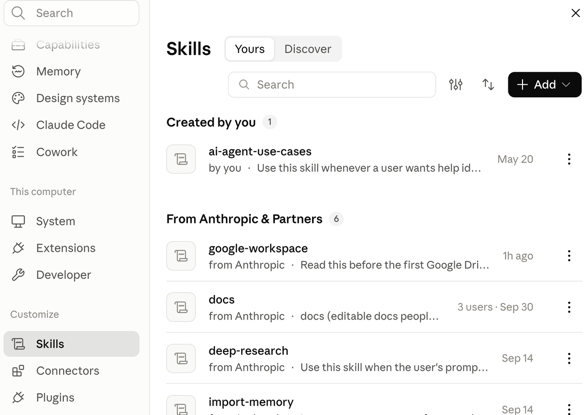
Skills A folder of instructions and resources that teaches an AI agent how to do a specific kind of task. At its core is a “SKILL.md” file with a name, a description (which tells the agent when to use it) and step-by-step guidance, optionally with templates, reference documents and scripts. The agent reads only the description up front and loads the rest when a task matches. It is an open standard used by Claude, Codex, Gemini CLI and others. In short, it represents knowledge: ‘how to do something’.
-
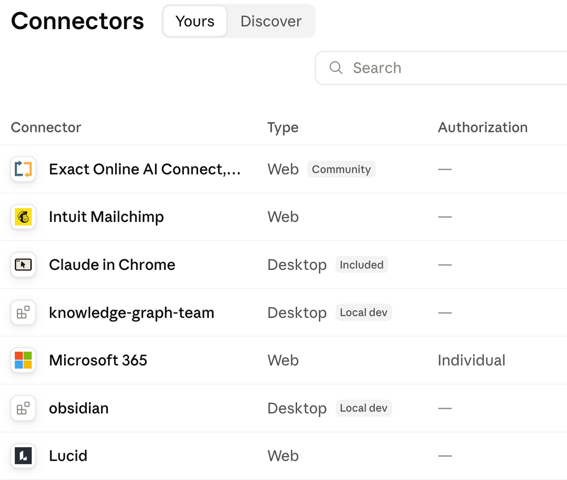
MCP (Model Context Protocol) or “Connectors” MCP is an open protocol that lets an AI agent connect to external systems. An MCP server exposes tools (actions like “create ticket” or “query database”), resources (data like files or records) and prompts to any compatible AI client. They are therefore often referred to as Connectors. Connectors are supported by Anthropic, OpenAI, Google, Microsoft and most agent frameworks. In short, this represents access.
-
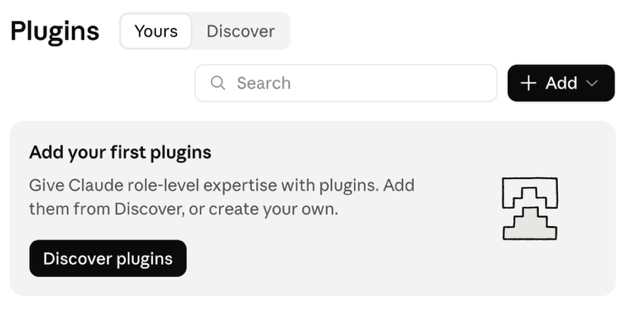
Plugins An installable package that bundles skills, MCP connectors, ‘slash’ commands and sometimes sub-agents or hooks into one unit, usually aimed at a role or workflow. Plugins are distributed through marketplaces, which are repositories with a manifest listing the plugins. Unlike skills and MCP, the plugin format is vendor-specific: Claude and Codex each have their own manifest. In short, this is the package for distribution.
Summary: a skill tells the agent how to do the work, an MCP connector gives it access to the systems it needs, and a plugin ships both to users as one installable product. Developers can create skills and connectors, with compatible plugins, for the major LLM platforms.
Everyone knows everything about everything
If we go back to the human resource manager, marketing specialist, accountant or fitness instructor, they can go to the plugin store for the LLM they use, search for, access and use specific plugins from suppliers who package their knowledge into downloadable plugins, just like an app for your smartphone!
Here are some links to plugin stores for your language model. Open a new chat and ask the model to search for a plugin in the category you want, then enable it and gain access to your new knowledge (or perhaps learn to fly a helicopter?).
- Anthropic Claude: GitHub repository of skills and plugins
- OpenAI ChatGPT: GitHub repository of skills and plugins
- Google Gemini: GitHub repository of skills and plugins
- Mistral does not offer a repository (at the time of writing).
Note: in a later article in this series, we will discuss how corporates can safely capture, share and offer knowledge to employees in a controlled and secure manner.
Want to think this through for your own team?
Book an introductory call. We reply within two working days.