Becoming AI Native – Step 4: Knowledge sharing via an AI Brain
23 November 2026 · by Alex Dowdalls
How often have you encountered one of the following problems:
- Your colleague was working on a key deliverable but has phoned in ill and nobody can take over their work, so the deliverable has to wait for their return.
- You remember having performed a task but can’t remember exactly which steps to follow and the software you use has since been updated and looks different.
- You have to apply a policy but that refers to other policies and it takes too long to find and re-read these to identify which rules to apply in this case?
These are examples of when we need knowledge which may exist in our organization but either only resides in the head of a colleague or can’t easily be found and shared. Since the dawn of time, humans have however distinguished themselves in the animal kingdom with the ability to share knowledge by observation or writing – the invention of printing revolutionised written communication.
Fast forward to our information age and we have replaced printing on paper with electronic distribution of documents such as html, word, powerpoint or PDF. When knowledge is captured in a document, we can share this via an intranet or collective storage but we still have three fundamental problems:
- if knowledge only resides in someone’s head, it does not get shared
- search and retrieval require the user to know what they are searching for, often literally knowing which key words to use in the search
- consuming knowledge takes time and may require the receiver to read and understand a large amount of text to find the knowledge they really need.
The key question is: Can this be done differently with AI?
The answer is yes and it requires a fundamental shift in how we capture, store, find and consume knowledge (not just data or information): we shift from working with literal documents to using semantic context – in plain language – we start working with an organisational brain!
Let’s break this down into three key steps:
1. Capturing knowledge – as we work – in a format that AI can share
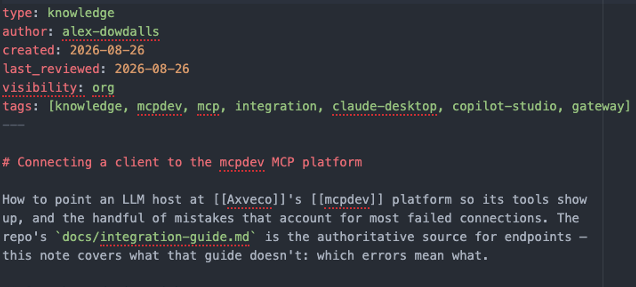
The first step is to set up a structure around how we work that captures knowledge in a machine-readable form. This is commonly a ‘mark down’ document, i.e. a version of a human readable document such as PDF but in a machine-readable format (e.g. .md instead of .pdf). Existing policies, guidelines and other references can be translated into this format to capture the knowledge they contain.
2. Making knowledge available and findable to those who need it
The next step is to enable knowledge to be found based upon its meaning, rather than the literal words that are used. A good example of this is found in the EU AI Act – if you search literally for ‘forbidden AI systems’ it will return ‘Not found’ but a semantic search using the meaning of the same input will find ‘Prohibited Practices’.
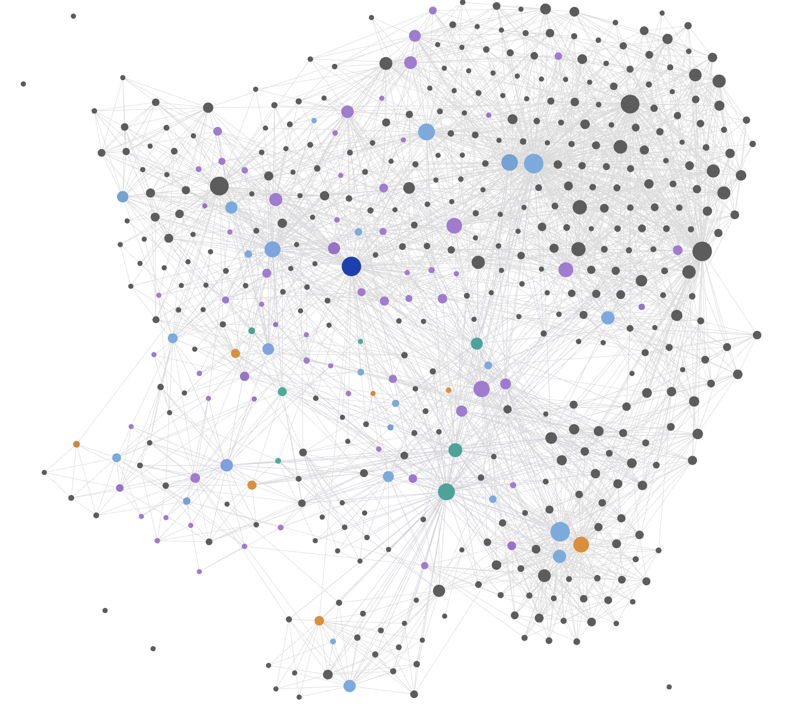
This shift from literal to semantic search transforms our ability to find and access the knowledge that we need! This can be supported by indexing the knowledge using a ‘knowledge graph’, which enables AI to search and find relevant knowledge quickly.
3. Applying knowledge to accelerate and improve how we work
The last step is to integrate the use of AI into the natural work processes of people in an organisation. This involves setting up a cycle of knowledge capture, review and provision. Instead of having employees only working directly with ‘rule based’ systems or enterprise applications, we place a ‘knowledge capture’ AI layer before this and a ‘knowledge management’ process behind it. Humans will decide:
- what is formal policy that must always be applied
- which knowledge is recommended to be available widely, and
- which is relevant to know e.g. a colleague’s progress on an activity.
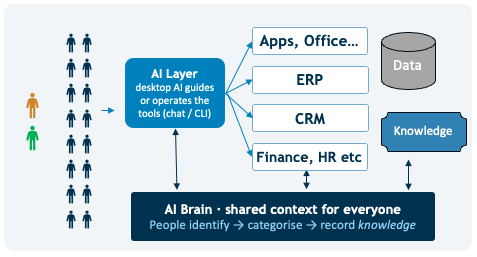
Knowledge can now be captured, classified and provisioned via the brain to all who need it! This provides an ‘enterprise context layer’ for all employees in which to work with AI – more simply referred to as an organisational ‘Brain’.
Setting up your Brain
The Brain can be set up to work with many different AI systems including ChatGPT, Claude, Gemini, Mistral and Copilot. The architecture depends upon the AI platforms and IT systems environment you have or wish to use.
The key to success is to establish and maintain a knowledge management process that builds the ‘brain’ over time. This includes three key elements:
-
Canonical
Reviewed organisational truth. Decisions, policies, procedures. If this is wrong, we want to hear about it. Owned, dated, superseded rather than overwritten.
-
Curated knowledge
Reviewed enough to be useful and generally trusted. Where most durable knowledge lives.
-
Capture mechanisms
Anyone writes, nothing is reviewed. Zero friction by design. Triaged or discarded. Mechanisms include ‘inbox’, AI session capture, macro commands to push content to the vault…
The Capture Mechanism codifies knowledge at the source of creation, the Curated Knowledge layer contains the knowledge that humans have decided is best to share widely and the Canonical contains policies or standards that are always mandated (such as your brand and style guide).
Once such a brain is established, you have cleared the biggest hurdle to becoming an AI Native organisation.
Want to think this through for your own team?
Book an introductory call. We reply within two working days.